Digging at Davis Farms in Terrell County

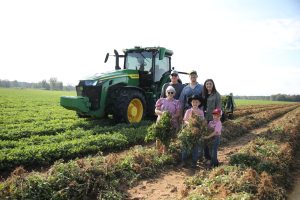
The first stop of the 2024 Georgia Peanut Tour was a stop at the 102 year old farm, Davis Farms, in Terrell County, Georgia. Davis Farms is owned and operated by Glenn and Riley Davis. They farm peanuts, cotton, corn, soybeans and pecans on approximately 4,500 acres. Riley is a fourth generation farmer and feels very fortunate that his father helped him get a start in farming once he finished college. Riley hopes to be able to pass the love of farming onto his three boys, Luke, Drew and Landon.  Learn more about Riley and why he is proud to be a Georgia farmer from a WALB News Interview.

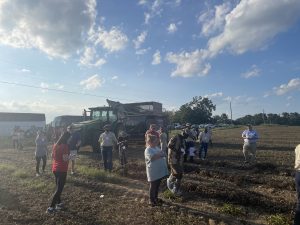
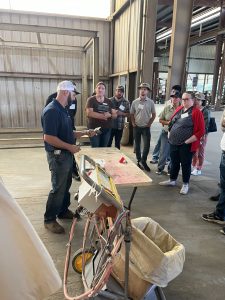
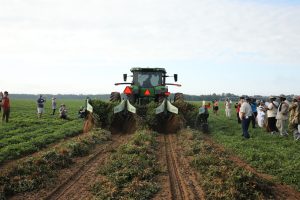
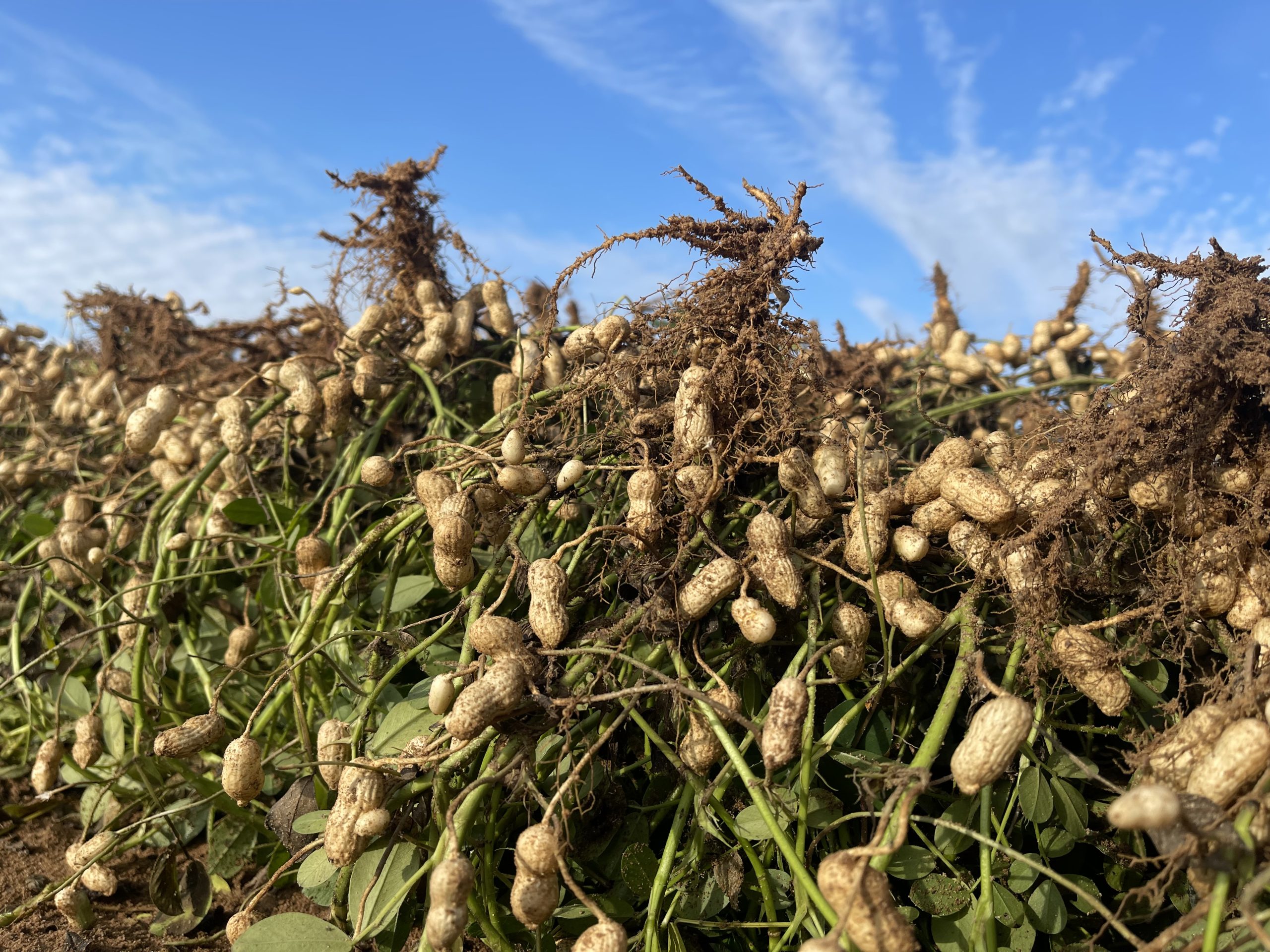
This stop highlighted the first step of harvesting peanuts which includes digging the peanuts up out of the ground. The field of the runner type of peanut, Georgia-12Y, was planted April 15 and is currently 152 days old. According to recent maturity tests of the field, the field has about 10 to 14 days until it reaches full maturity. Digging too early can cause a loss so farmers use the peanut maturity board and pod blasting to determine the optimum time for digging their peanuts.

The field was planted behind a cover crop of black oats and radish. Riley strip tilled the peanuts in at planting. Throughout the season, Riley has an issues with drought in the dry corners of the field where the irrigation does not apply water to the crop. He has also had issues with spider mites which thrive in dry conditions.

Terrell County, Georgia is in the heart of peanut production in the state. According to Seth McAllister, Terrell County Extension agent, the county has 60,000 acres of row crops. Many farmers in the county plant using a 3-year rotation of corn, cotton and peanuts.

To learn more about peanut production in the state of Georgia, click here.

View the 2024 Georgia Peanut Tour Photo Album.

Welcome to the 2024 Georgia Peanut Tour

We are delighted to welcome you to the 2024 Georgia Peanut Tour and thank you for your participation. Whether you’re joining us for the first time or you’re a seasoned “Peanut Tour Veteran,” we are thrilled to have you on our 36th tour. As in previous years, you’ll gain an in-depth look at the production of one of Georgia’s key agricultural crops. We hope this experience will provide you with a deeper understanding of both the challenges faced by our farmers and the reasons we proudly declare that Georgia grows the best peanuts in the world. Our goal is for you to develop a greater appreciation for the rich heritage of peanut farming in our state. Those involved in the peanut industry—farmers, buyers, processors, researchers, Extension personnel, and Georgia Peanut Commission representatives—take great pride in Georgia’s position as the leading peanut-producing state in the U.S., and we’re excited to showcase this year’s crop to you.
The 2024 Georgia Peanut Tour is staged in the central region of our state’s production area and begins on the afternoon of Tuesday, Sept. 17, with a “Hot Topics” symposium. Expert speakers will address the status of this year’s peanut crop and provide a special focus on sustainability within the global peanut industry.

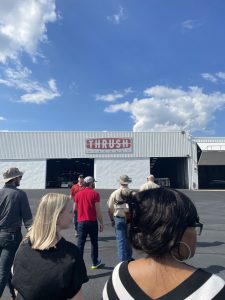
The two days that follow will provide you with the opportunity to learn more about production, research, processing, and more. Field visits will provide you with a glimpse of peanut production, digging and harvest. The University of Georgia and U.S. Department of Agriculture researchers will provide updates on innovative research projects at the Southwest Georgia Research and Education Center in Plains, Georgia and the USDA-ARS National Peanut Research Lab in Dawson, Georgia. The tour also includes visits within the supply chain to Olam Shelling Plant and Locke Farm Center. Attendees will also tour GreenPoint Ag, Nolin Steel, Thursh Aircraft, Amadas, and more!

Once again, on behalf of the Peanut Tour Committee, which includes members from the Georgia Peanut Commission, the University of Georgia, and the USDA-ARS National Peanut Research Lab, I extend a warm welcome to the 36th Georgia Peanut Tour! Over the next few days, we hope you gain a deeper appreciation for the complexities of Georgia’s peanut industry and the dedication of those involved in producing the world’s finest peanuts. We aim for our events to foster fellowship and allow you to experience the best of southern hospitality while exploring the beautiful, rural areas of our state. We also extend our heartfelt thanks to our sponsors, whose generosity makes this tour possible. Please feel free to reach out if you need assistance navigating through our state’s production areas. We take great pride in our peanut farmers and industry and are excited to share them with you.


2024 Georgia Peanut Tour set for Americus area

The thirty-sixth annual Georgia Peanut Tour will be held September 17-19, 2024, in Americus, Georgia, and the surrounding area. The tour brings the latest information on peanuts while giving a first-hand view of industry infrastructure from production and handling to processing and utilization. Tour stops will be made in several peanut producing counties in South Georgia.
Attendees can expect to see first-hand nearly every aspect of peanut production in the state. This year’s tour hosts many exciting stops including on-farm harvest demonstrations and clinics, as well as, research at the University of Georgia Southwest Georgia Research and Education Center and the USDA-ARS National Peanut Research Lab.

Hotel accommodations can be made at the host hotel, The Windsor in Americus, Georgia by calling 229-331-7076. A standard room ranges from $129 – $199++ (depending on room type). Breakfast is not included in the room at The Windsor. Be sure to ask for the 2024 Georgia Peanut Tour room block when making a reservation. Additional rooms are available at the Hampton Inn in Americus. A standard room is $129++ (breakfast included). Call 229-924-3890 and mention the Georgia Peanut Tour for a discounted rate. The room block’s deadline is Aug. 16, 2024.

For attendees flying, the closest airport is the Southwest Georgia Regional Airport in Albany, Georgia.

For specific tour info or details, contact David West at 229-386-3470.

The Georgia Peanut Commission, University of Georgia College of Agricultural and Environmental Sciences and the USDA-ARS National Peanut Laboratory coordinate the tour.

Registration for the 2024 Georgia Peanut Tour is now closed.
Download Sponsorship Packet
Tour Schedule
Map & Driving Directions – Wed., Sept. 18 & Thurs., Sept. 19.

Grower-Owned Peanut Processing Facility

During the final stop on the Georgia Peanut Tour attendees were able to tour the grower-owned peanut processing facility, American Peanut Growers Group, which is based in Donalsonville, Georgia. Throughout the tour, attendees were able to visit the buying point, shelling plant, blancher and learn more about APGG’s new peanut ingredient processing facility. APGG was formed in late 2002 and the company includes two buying points, two shelling plants, one blancher, one cold storage facility, multiple warehouses, a feed mill, a solar field for renewable energy and their newest venture, a ready-to-eat peanut ingredient facility.
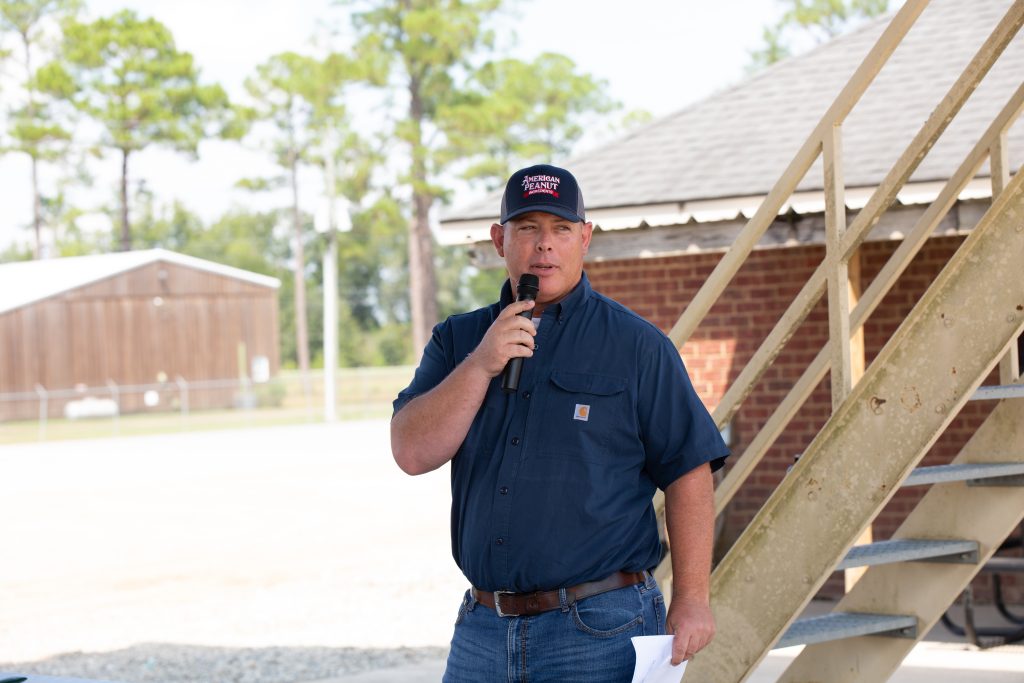
Neal Flannagen, president and CEO of APGG, welcomed attendees to APGG and provided an overview of the facility. The first step of the process includes peanuts arriving to APGG from the farm. APGG currently processes 80,000 tons of farmer stock peanuts at their buying point.
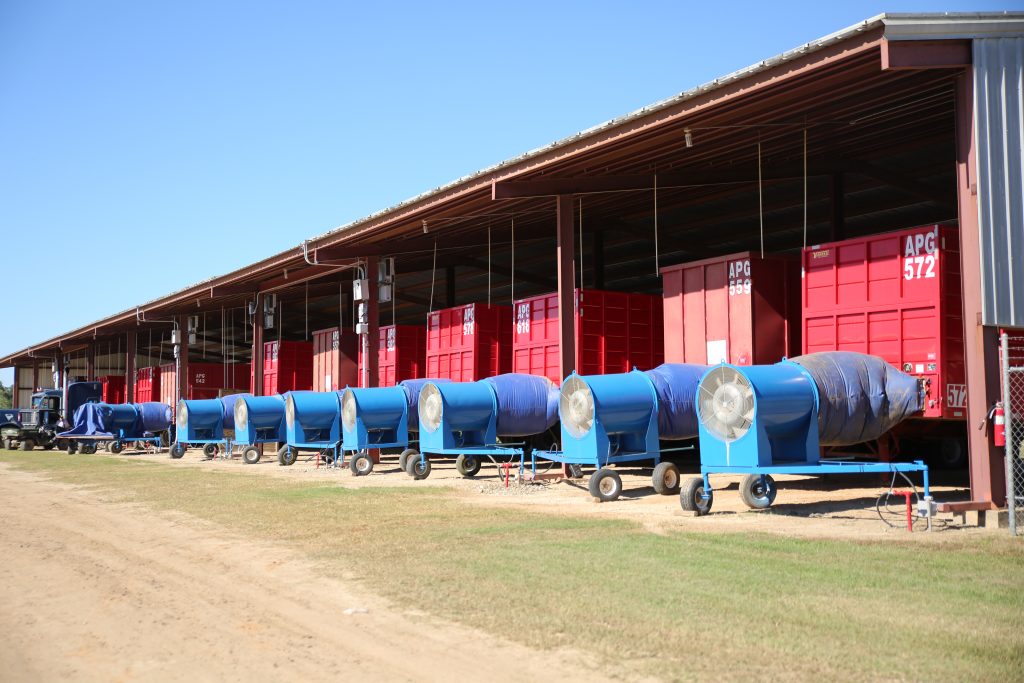
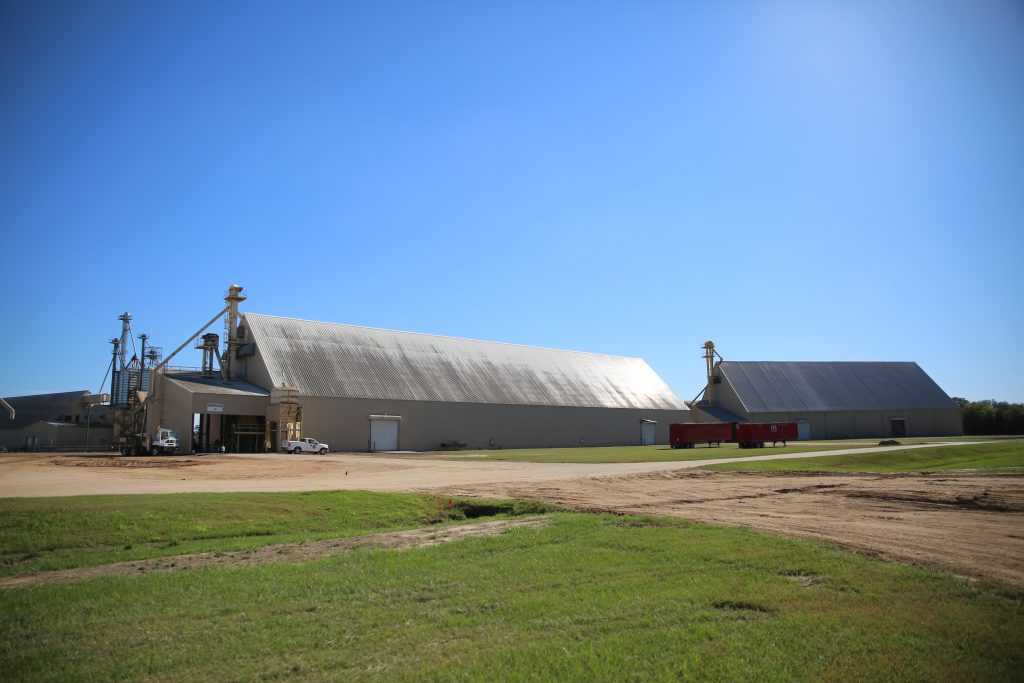
When peanuts first arrive their moisture level is checked. If the moisture level is not below 10.49 percent, then the peanuts are sent to the drying shed. Once peanuts are dried, they are cleaned if needed and then they are inspected and graded by the Georgia Federal-State Inspection Service. Then the peanuts are stored in a warehouse on-site at APGG until they are needed.

APGG sells raw and blanched peanuts to all major peanut product manufacturers in the U.S. and many companies worldwide. APGG offers bulk packaging to their customers through rail cars or semi-trucks. Additionally, APGG exports peanuts to customers in South America, Europe and Asia, through the port of Savannah, Georgia, which is one of the busiest ports on the east coast of the United States.

APGG has the ability to roast 20,000 pounds of peanuts per hour. After roasting they temper the peanuts for six to eight hours before shipping. Peanuts can also go to the blancher where the red skin is removed. The blanched peanuts are sorted by size, splits are removed, and orders are shipped based on customer specifications.

In 2022, APGG began their newest venture with the creation of the American Peanut Ingredients, LLC (API). The new 140,000 square-foot facility includes an additional shelling plant and a ready-to-eat peanut ingredient plant. The new venture allows API the ability to sale peanut butter in bulk, peanut paste or as a granule.

One unique thing about the grower owners of APGG is that they have a higher percentage of irrigated land than the state average for Georgia. All of the APGG farmer members are excellent growers who deliver exceptional quality and high yields to APGG’s shelling plants.

For more information on APGG visit their website at www.apgg.com.

View the 2023 Georgia Peanut Tour Photo Album


Peanuuut, Peanut Butter…& Jelly!

While at LMC Manufacturing, tour attendees had an opportunity to sample grilled peanut butter and jelly sandwiches made by Tyron Spearman, executive director of the National Peanut Buying Points Association.

Tyron Spearman (left) and Wesley Powell grill peanut butter and jelly sandwiches for the tour attendees.

Each year, Spearman joins attendees on the tour and gives them a taste of America’s favorite sandwich with a unique twist. Spearman says the key to a great grilled PB&J is to mix your peanut butter and jelly together first before spreading it on the bread. After that, you can butter each side of the sandwich and grill it just like you would a grilled cheese. Be sure to try it at home!

Below is a throwback video from the 2016 tour, where Spearman describes the simple process of making your own grilled PB&J.

View the 2023 Georgia Peanut Tour Photo Album

Still Going Strong After 80 Years

Lewis Carter, Jr. welcomes Georgia Peanut Tour attendees to LMC Manufacturing in Donalsonville, Georgia.

After leaving SunSouth, tour attendees headed over to LMC Manufacturing. With a history of more than 80 years, LMC has been a leader in producing world class machinery. The company offers solutions tailored to meet the needs of a specific industry and/or company. From gravity separation machines and destoners to vibratory conveyors, LMC produces custom-built industrial separation equipment for the customer’s unique processing requirements.

Throughout the years, the Carter family has built equipment ranging from peanut shellers for Georgia farmers to bow hooks for the Navy during World War II. At the root of it all remains the consistent mechanical innovations helping numerous industries operate smarter and more efficiently.

LMC’s focus on process application separates it from other manufacturers. This focus drives them to understand the process and design applications with specific purposes. LMC equipment is custom-built for the required process whether for a food product or recyclable materials and is adaptable for a variety of commodities.

LMC is committed to delivering peanut processing systems and equipment to help peanut processors achieve maximum capacity and efficiency for their dollar. Originating from the rural peanut farms of South Georgia, LMC has become the world leader in peanut shellers and equipment for the peanut shelling process. LMC equipment is responsible for shelling 90 percent of the commercial peanut market. These machines are designed specifically to maximize processing speed along with separation effectiveness.

What makes LMC unique is the staff of peanut specialists that can design, build, deliver and install an entire peanut processing operation. From cleaning to separating, back to cleaning and shelling, LMC equipment can go through the entire process customized to the customer’s specifications. Also, by removing the lower-grade peanut prior to shelling, the end-produce will be of the best quality, yielding the ultimate monetary profit.

Below are some of the types of peanut processing systems LMC can design and build from the ground up. To learn about each, click here.

  • Peanut Shellers
  • Sizing Shakers
  • Destoners
  • Aspirators
  • Peanut Blanchers
  • Vibratory Conveyors
  • Gravity Separators
  • Easy Dump Elevators
  • Air Gap Cleaners

With LMC’s large range of peanut customers, they have made contacts all across the globe including: South America, Australia, the Middle East, Europe and the Western United States including California.

Click the video below to learn more about LMC and the Lewis Carter Family.

View the 2023 Georgia Peanut Tour Photo Album


The Value in a Peanut Crop

Georgia Peanut Tour attendees began Thursday morning at SunSouth in Donalsonville, Georgia. SunSouth, LLC formed in June 2006. Joining forces with several local tractor cornerstones, SunSouth began with 11 stores, and by 2016 grew to 21 locations in Alabama, Georgia and Mississippi. The SunSouth team prides itself on integrity, quality, commitment and innovation.

SunSouth representative, Russ Worsley, shows tour attendees a KMC digger.

During the stop, SunSouth employees discussed the different types of equipment farmers use to produce a crop of peanuts and the investment it requires. From John Deere tractors to peanut planting and harvesting equipment, as well as equipment to spray the crop when necessary, SunSouth offered tour attendees a chance to understand the cost associated with farming.

Tour attendees learn about the investment of an Amadas combine.

John Deere tractors are on display for tour attendees.


Below is a list of some of the equipment discussed and the estimated cost associated with each:

To put it into perspective, a farmer’s peanut yield would have to be near 4,500lbs per acre to breakeven at $535/ton.

View the 2023 Georgia Peanut Tour Photo Album

Peanut Picking Time


During a stop at Glenn Heard Farms in Brinson, Georgia, Georgia Peanut Tour attendees had the opportunity to see first-hand the process of harvesting peanuts. Heard is a third-generation farmer who grows wheat, milo, corn, cotton, peanuts, sweet corn, and carrots. Heard farms right in the heart of peanut country in Decatur and Seminole counties.

Peanut harvesting is a multi-step process. Digging, which is first, is the process of removing the peanut from the ground, shaking off any excess soil, rotating the plant, and then leaving the plant in rows, allowing the peanut to release moisture before being picked from the vine once dry. Farmers must monitor the maturity of the peanut crop before commencing the important task of digging. If removed from the ground too early, the peanuts will not reach the necessary maturity to meet accepted standards for grading. To reach maturity, the peanut growing period is 140-150 days following planting.

After a few days left to dry, peanuts are ready to be picked. Peanuts are picked with a combine. The combine separates the peanuts form the vine, placing the peanuts in a hopper on the top of the machine and depositing the vines back into the field.

Learn more about Glenn Heard Farms by watching the 2021 Through the Eyes of a Farmer video he was featured in.

View the 2023 Georgia Peanut Tour Photo Album


Rugged. Reliable. Equipment. – Harrell Ag Products

After enjoying lunch, the Georgia Peanut Tour attendees traveled a short drive up the road to learn more about the equipment farmers need and use in peanut production.

“We design and build farm and land development equipment to give our customers peace of mind that our products will always perform on demand no matter how demanding.” This is the mission statement of Harrell Ag Products, located in Bainbridge, Ga.

Brandon Ellerbee, Harrell Ag Sales Manager, visits with GPT attendees.

Since 1954, the Harrell Family has served the farming community with innovative products, service, parts and technical support that their customers expect and deserve. From land preparation to harvest, Harrell Ag has developed products to meet the farmer’s need every step of the way. In the late ’50s, they introduced the 4-Row Vada Cultivator frame, and in the ’60s and ’70s, they developed a line of cotton and peanut transport equipment, as well as on-farm crop drying equipment. Later in the 1980s and 1990s, cotton module builders, boll buggies and module feeder systems were added to their line up.


The on-land switch plow, which is still used around the world today, was patented by Harrell Ag. In the past 20 years, they have continued innovation by introducing new products like a crop chopper, cotton stalk puller and the rock-n-root rake.


With almost 75 years of manufacturing agricultural equipment, the team at Harrell Ag understands the needs of the farming community.


To learn more about their products, click here.

To locate a dealer near you, click here.

View the 2023 Georgia Peanut Tour Photo Album

What is a peanut entomologist?

Mark Abney, peanut entomologist at the University of Georgia, provided an overview of his work during the 2023 Georgia Peanut Tour. He receives the question many times from people asking, what does the peanut entomologist at University of Georgia do?

According to Abney, peanuts are not really any different than other agricultural commodities and the focus now is on sustainability.

“In order to be sustainable, you have to be profitable and insects threaten profitability right,” Abney says. “Insects in the field are going to eat the crop and they are either eating the leaves and we need leaves to make peanuts or they are eating the peanuts.”

At the end of the day, insects can cost growers money. Even though, Abney can find insects in almost every field in Georgia, the insects do not always need to be controlled. Some of the insects are pests while some of the insects are beneficial. In some cases, the insects present may be a pest but the population in the field may not warrant an insecticide application.

For growers, trying to manage insects can be troublesome. That is where Abney sees his role as the peanut entomologist in helping growers. Abney conducts research on the insects that occur in peanuts, develops thresholds and evaluates chemistry of products for insect management.

When Abney evaluates chemistry, he looks at the insecticides that are available, what works best, what is most economical to put on the peanut crop to manage the insect pests that farmers have so they can preserve yield and preserve profitability.

According to Abney, it is important for individuals to know that farmers don’t kill insects for fun. Farmers work to manage insects in their field and should use insecticides in crops when the insect pest is going to cause yield loss.

“If they’re going to cause yield loss that costs more than what it costs to kill them, then that’s the only time we should manage insect pests in the crop,” Abney says.

Every year is different in terms of insect and disease pressure and 2023 is no different. This production year started out cool and with thrips pressure and tomato spotted wilt virus. In August, farmers had caterpillars including velvet bean caterpillars come in the last few weeks of the growing season.

Abney’s research and extension program focuses on determining what the best products are, what the best tools are and what the best practices are to reduce the risk of insect injury and then control those insects or manage those insects when they do occur in the field.

So, when it gets right down to it the goal of my research and extension program is to understand the insect pests that are present and learn how to best manage them,” Abney says. “Then what can we do to manage them when they occur and then get that information out to our growers so that they can implement those practices on their farm and ultimately preserve yield and profitability.”

View the 2023 Georgia Peanut Photo Album.