 The 29th Annual Georgia Peanut Tour is ready to kick off today at the Rose City Conference Center in Thomasville, Georgia with the Hot Topics Seminar. The three-day event showcases all aspects of peanut production from the farm to peanut processing facilities. This year we are proud to have participants from 13 states and two countries on the tour. We are excited to have you travel with us as we visit various sites to learn more about the effort, care and even passion invested in producing the world’s finest peanuts! We sincerely appreciate each of you for joining us on this exciting tour that will introduce you to the peanut industry in Georgia, and hope through the experience of this tour, you will understand and appreciate the heritage of peanut production in our state. Each of us engaged in the peanut industry – farmers, buyers, processors, researchers, extension personnel, Georgia Peanut Commission representatives and everyone in between, are proud Georgia is the leading peanut producer in the United States, and we couldn’t be more excited you are joining us for the next three days!
Author: joycrosby
Georgia Peanut Tour set for Sept. 15-17, 2015
 The twenty-ninth annual Georgia Peanut Tour will be held September 15-17, 2015, and located out of Southwest Georgia at the Best Western Rose City Conference Center Inn, Thomasville, Georgia. The tour brings the latest information on peanuts while giving a first-hand view of industry infrastructure from production and handling to processing and utilization. Tour stops will be made in several peanut producing counties including Thomas, Grady, Decatur, Seminole and Early County.
Attendees can expect to see first-hand nearly every aspect of peanut production in the state. This year’s tour hosts many exciting stops including on-farm harvest demonstrations and clinics, peanut processing facilities, and several special highlights which include research at the University of Georgia Research & Education Center in Attapulgus, Lewis M. Carter Manufacturing, Fudge-Birdsong Peanuts Buying Point and Birdsong Peanuts Shelling Plant.
The tour kicks off this year with the Hot Topics Seminar on Sept. 15 at 3 p.m. at the Best Western Rose City Conference Center Inn, Thomasville, Georgia. The seminar topics include an update on the 2015 Georgia peanut crop, a Washington legislative update and consumer peanut information including peanut flour and oil as well as probiotics in peanut butter.
The Georgia Peanut Commission, University of Georgia-Tifton Campus and Griffin Campus, Southwest Research & Education Center, Attapulgus Research & Education Center, and the USDA Agricultural Research Service National Peanut Research Lab coordinate the tour.
Hotel accommodations can be made at the Best Western in Thomasville, Georgia, by calling 229-226-9998. Rooms are available at the rate of $101 for a single/double room and $115 for a suite. Once the Best Western is full, additional hotel accommodations can be made at the Holiday Inn Express & Suites by calling 229-226-4666. Be sure to ask for the Georgia Peanut Tour room block.
Visit georgiapeanuttour.com to register and view tour schedule. For more information, contact Hannah Jones at hannah@gapeanuts.com or call at 229-386-3470.
Register online
Print registration form
Tentative Tour Schedule
View Sponsorship Packet
Harvest at Hub Daniel’s farm
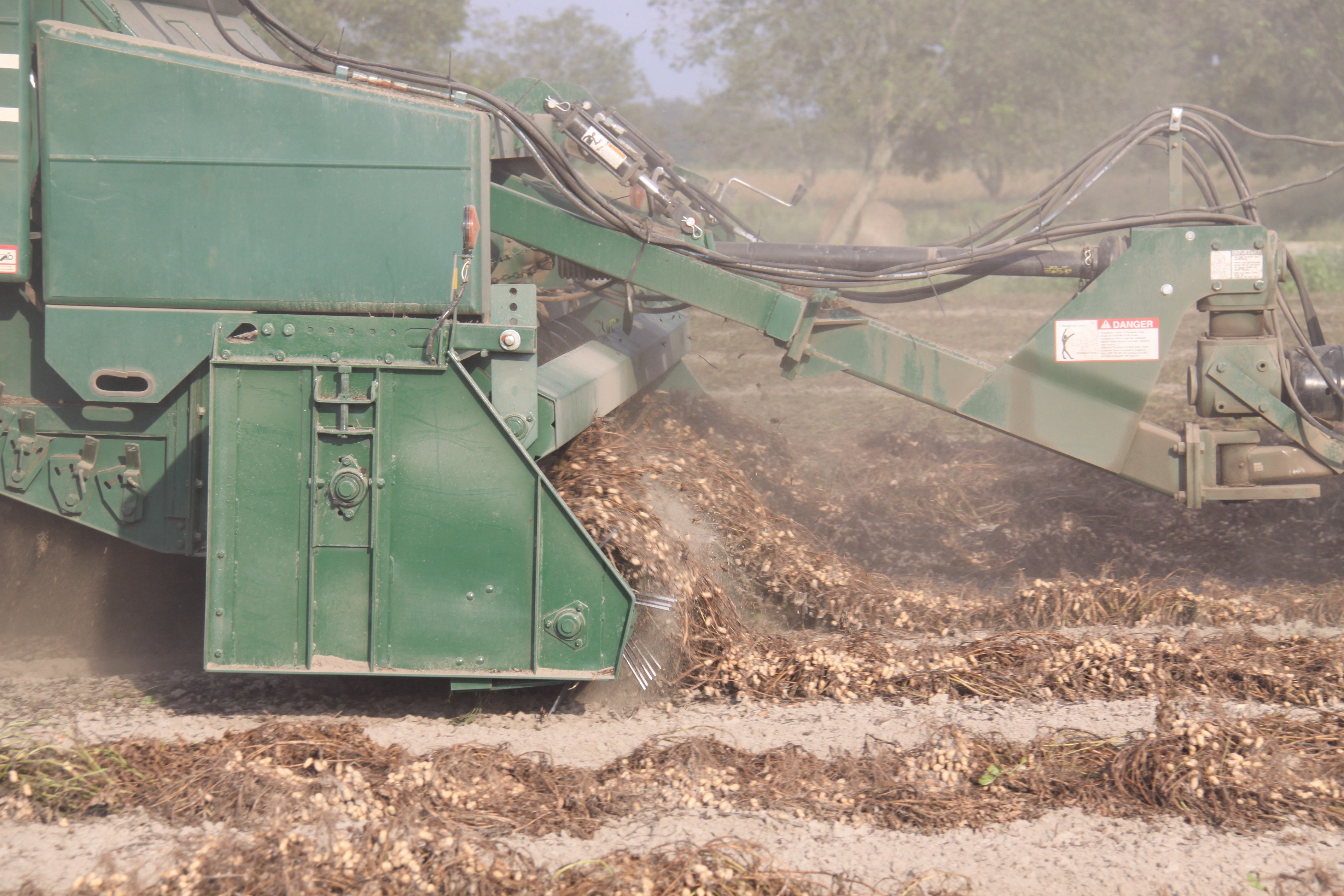 The last field stop on the 2014 Georgia Peanut Tour allowed attendees to see harvest up close at the farm of Hub Daniel in Tattnall County. At earlier field stops the ground was too wet for farmers to demonstrate peanut digging or picking. Daniel is a fifth generation farmer and has been farming for 34 years. He grows 2,700 acres of peanuts, corn, soybeans, cotton, wheat, rye and pecans. Check out this video where WTOC recognized Hub Daniel. While at the farm, attendees were able to see Daniel harvest his peanuts with a KMC combine and continue to pick peanuts by using KMC’s unload on-the-go. This option saves farmers time loss to dumping by allowing continuous harvesting.
Unload on the Go
New products for disease control
Bob Kemerait, Georgia Peanut Tour chairman and University of Georgia Extension Plant Pathologist, reviewed some of the new products available for growers in 2015. His main focus is helping to train county agents and work with the growers in terms of management and reducing the impact of diseases in their fields. He is also given the opportunity to conduct research on new products for the management of leafspot, white mold and other soilborne diseases in peanuts.
Peanut disease update
Attendees also learned about peanut diseases from Dr. Tim Brenneman, University of Georgia research and Extension plant pathologist. His main research on peanuts revolves around soil borne diseases including white mold, Rhizoctonia, Cylindrocladium black rot. He also works on nematodes and nematode management. He works on a very active program developing fungicides and overall management programs for farmers. According to Brenneman, the 2014, crop has not been severe for disease issues so far. Early on we had a few issues with seedling disease, Aspergillus Crown rot and getting good stands established. That was early in the year so most farmers were able to get a reasonable stand. “Recently, we have had a lot of underground white mold and I think we are in the initial stages on seeing how that will develop,” Brenneman says. “I think there is a lot we will learn as peanuts are being dug.”
Calcium – important nutrient for peanuts
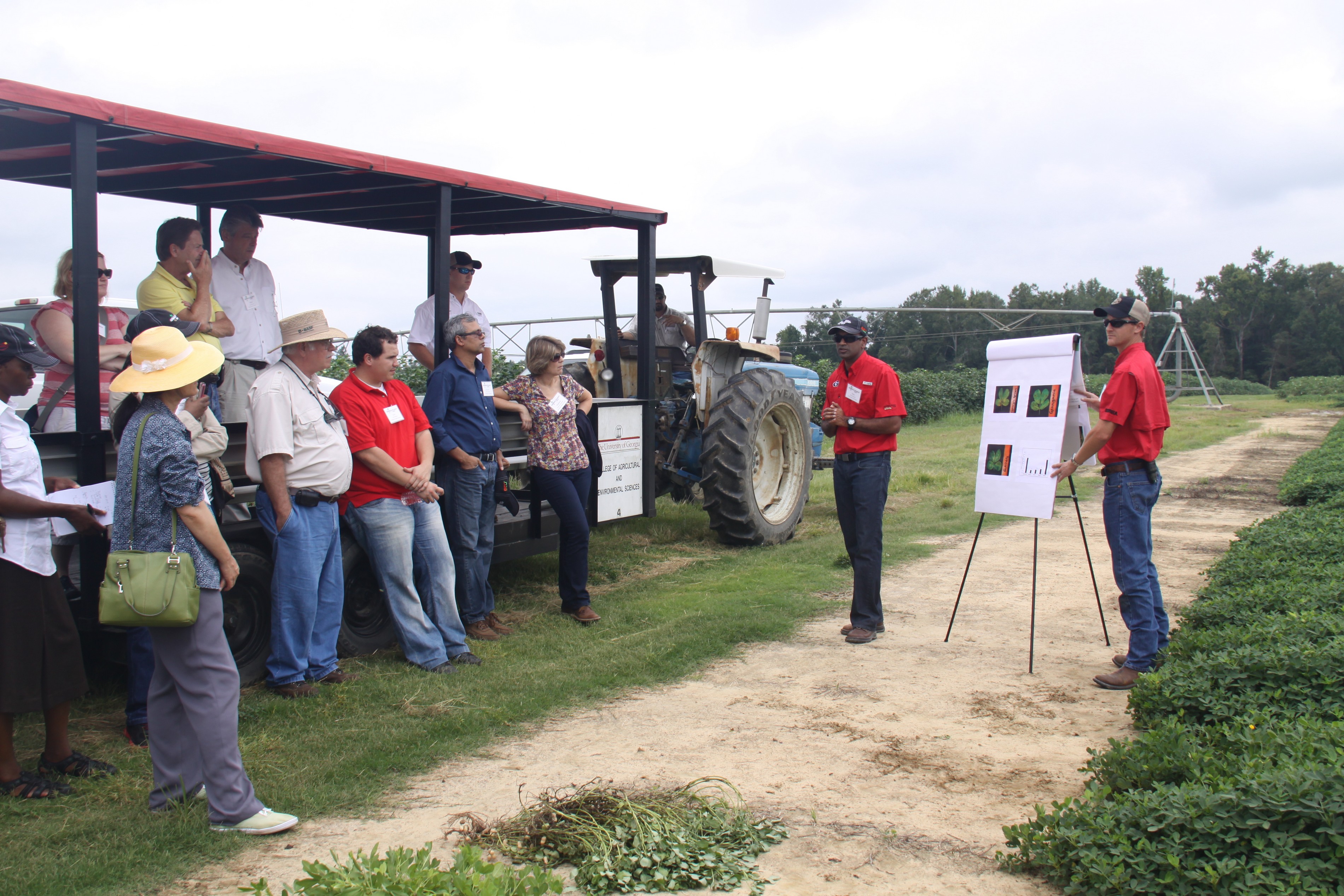
While at the Southeast Georgia Research and Education Center, Glen Harris University of Georgia Extension soils and fertilizer specialist visited with attendees about calcium nutrition for peanuts. For the last three or four years we’ve really focused on calcium nutrition on peanuts, Harris says. The focus started when the industry shifted from small seeded to large seeded peanut varieties. Harris has been comparing the varieties and the calcium requirements needed. According to Harris, he found out that growers can maintain using the University of Georgia old recommendations on the new larger seeded peanut varieties.
Since then, Harris’ research has shifted more into looking at ways of providing calcium to the pegging zone of peanuts which is really important for the yields. He is also looking at different gypsums, calcium chloride and lime through the pivot. Although, the old standard Extension recommendation is if you need calcium then apply 1,000 pounds of gypsum at bloom time is still the standard today for growers.
The 2014 peanut crop of irrigated peanuts look good but the dryland peanuts have suffered a little. As far as nutrients, Harris says, he hasn’t noticed any major nutrient problems. However, he is a little concerned with the calcium nutrition in dryland because you need the water to get the calcium into the nut so you don’t get pops. “So, we might find that we have a little lower yields and pops, due not only to the drought, but maybe even due to some calcium issues,” Harris says. He says there’s not a whole lot growers can do about that, if you do everything you can and still get dry weather. But overall, the 2014 crop, nutritionally, is looking very good, he adds.
Peanut pests in 2014
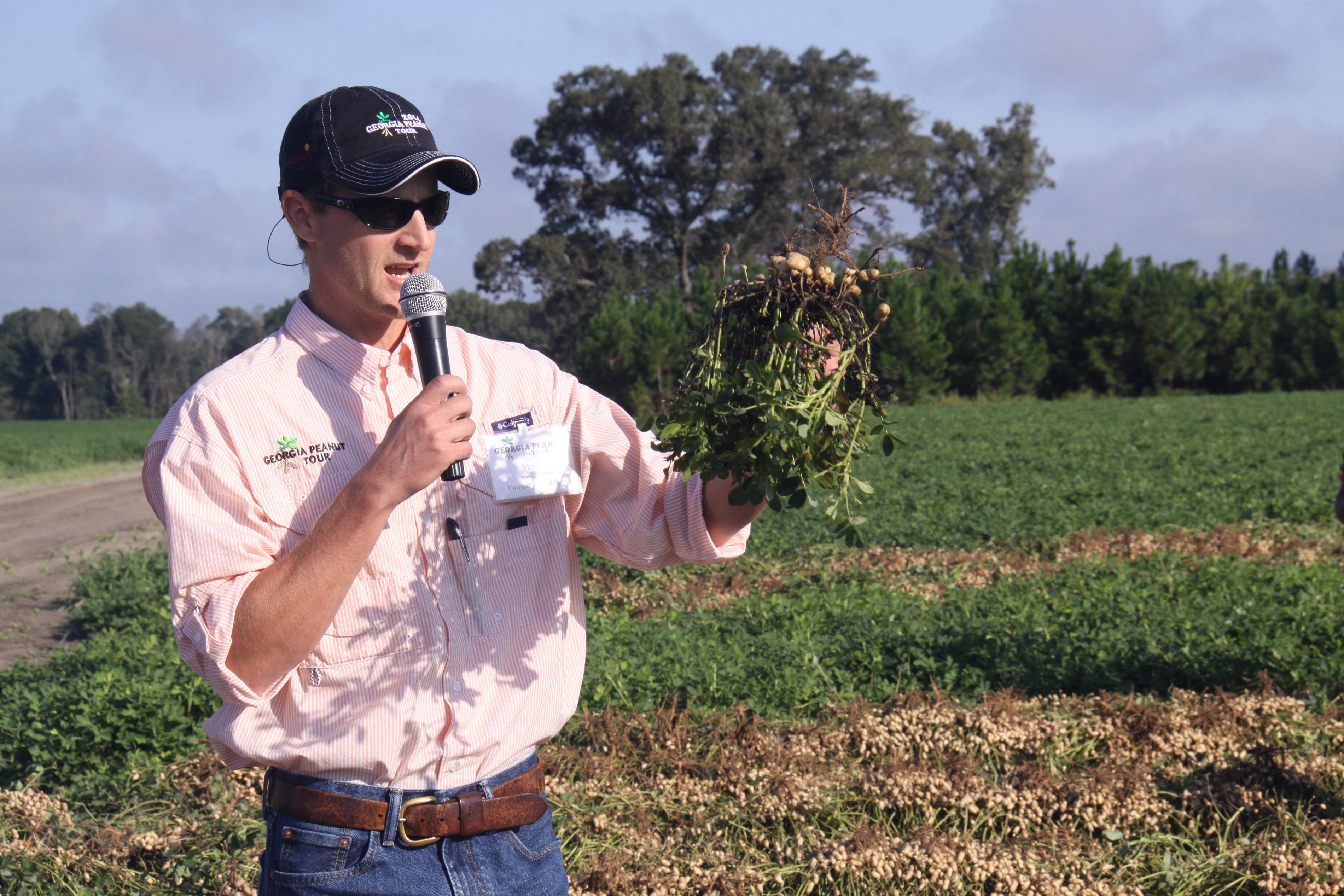 Mark Abney, peanut entomologist at UGA, visited with Georgia Peanut Tour attendees during the three-day tour on the various pest issues and the research he has been working on the last two years.
“Some of the things that are really exciting to me in terms of entomology research are the economic thresholds we are developing for a lot of the pests we have in peanuts,” Abney says. “That’s very important to growers so they know when to spray or not to spray so that we are not wasting money by not treating when we need to or by over treating when we don’t need to be spraying.”
Abney also has an efficacy testing program where he looks at all of the new chemistries and some of the older chemistries on the established pests we have to determine what is the best product to use for the pests we have in peanuts.
According to Abney, 2014 has been a very buggy year. He says the year started out early with thrips, very much like in 2013. Then growers went straight from that to some caterpillar problems that have been higher than a normal year.
The two things that have been really problematic for growers this year have been lesser cornstalk borer and two spotted spider mite. “Those are probably the two most important pests we have had in Georgia. They are not a pest every year but when they are it can be really problematic,” Abney says.
“We have spent a lot of money and heartache trying to control those two pests.” Both pests are very difficult to control especially in non-irrigated fields with the hot and dry conditions we have seen in 2014, he adds.
Abney credits the Georgia Peanut Commission for the research funding he receives and says it is extremely important for what he does at UGA. Without the funding, it would have been very difficult if not impossible to get his research program started. “We wrote a grant last year and received some money from the Georgia Peanut Commission which we were able to use to leverage with USDA to receive a larger grant from USDA this year,” Abney says. “This allows us to work on some of the thresholds for the key pests we have and without the Georgia Peanut Commission support we would not be able to do the research.”
Abney also has a blog where he provides growers the latest information on peanut pest issues at http://blog.extension.uga.edu/peanutent.
Research focus on tillage, row patterns, seeding rate & replanting
During the visit at the Southeast Georgia Research and Education Center Scott Tubbs, University of Georgia cropping systems agronomist, explained his research focus and provided an update on the 2014 Georgia Peanut Crop. The primary focus of his research program is to look at different aspects of peanut agronomics such as tillage, cover crop effects prior to the peanut crop, row patterns, seeding rates, plant populations, different planting date affects such as replanting and many other agronomics that effect various aspects of disease, entomology and weed science.
“Some of the primary issues of the 2014 peanut crop are mainly related to moisture and rainfall,” Tubbs says. “On the non-irrigated peanut crop we ended up with a lot of dryland peanuts that have not fully developed and are behind on maturity.” The yield looks like it will be suppressed. There was poor flowering and poor pod set on that crop early on when the rainfall stopped and we ended up with very dry conditions for the months of July and August. So those conditions are starting to become rectified with recent rainfall. However, we are getting to the point in the season where it is going to be difficult to make up the time we have lost for getting a good pod set and good yields on the dryland crop.
Some of the research funding from the Georgia Peanut Commission and the National Peanut Board are projects where I have looked at seeding rates and various replant decisions for peanuts. The trials are included in multiple locations throughout the state and at the Southeast Research and Education Center in Midville, Georgia. In these trials Tubbs looks at how important is it to get an established plant stand on the first planting. “If you can’t get a good established plant stand on the initial planting the amount of money it costs to go back into a field is costly to a grower,” he says. The additional costs include the cost of more passes through the field, additional cost of more seed and then also determining when is the appropriate time to dig based on maturity. With two different planting dates growing in the same field at the same it is very difficult to determine the optimum maturity. Because some peanuts will be over mature while others are immature.
A lot of information from the UGA Peanut Team is available online at ugapeanuts.com.
Technology on the farm
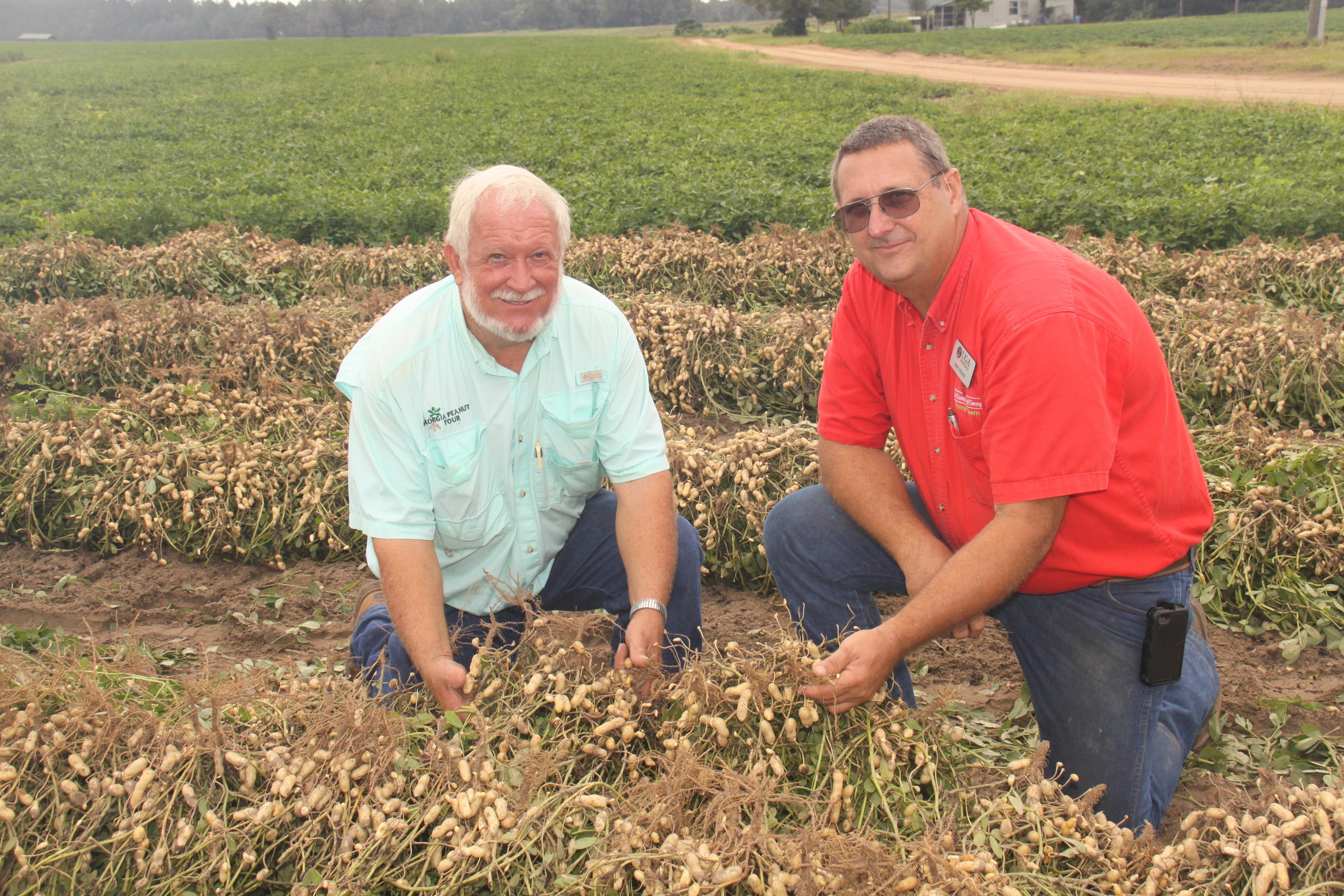
Joe Boddiford, Screven County peanut farmer, and Ray Hicks, Screven County Extension agent.
Joe Boddiford of Screven County, Georgia, visited with attendees during the first tour stop Thursday morning, Sept. 18, 2014. Boddiford has been farming since 1974 and follows in the footsteps of his father and grandfather. Joe took time to introduce his brother and cousin to tour attendees. “We have all been involved in agriculture our whole lives and we love it,” he says. He also introduced his son, Knapp Boddiford, and told a story about how Knapp got his name. His name comes from Seamen Knapp who actually drafted a bill for the establishment of experimental research stations, which later was introduced to the 47th Congress, laying the foundation for a nationwide network of agricultural experiment stations.
 Use of technology on the farm was the main focus of this tour stop at Boddiford’s farm. Boddiford pointed to a 1962 John Deere 3010 tractor that Boddiford started farming with in 1974. His father originally purchased the tractor in 1962. Boddiford farmed with the 3010 for a number of years and needed a new tractor in the 1990s so he sold it but later regretted it. After many years, Boddiford saw a John Deere 3010 tractor at an auction in South Carolina, recognized it as the tractor he had sold earlier so he purchased it again from the auction for more money than he originally sold it for. Today, Boddiford has told his son that the 3010 tractor is one piece of equipment he can’t sell.
When comparing the 3010 tractor to other equipment sitting beside it tour attendees can quickly notice how times and technology has changed throughout the years. Boddiford first became involved with the latest technology when he attended a precision ag conference in 1996 and has since worked with the Extension service on several research projects using auto steer, yield monitoring and more. Boddiford also uses swath control on his sprayers which helps prevent spray overlap.
In addition to learning about Joe Boddiford’s farm, attendees were able to hear from researchers at Clemson University on the work they are doing with variable depth digging and peanut yield monitoring.
Click here to view their presentation.
The visit would not have been complete without an example of peanut digging in the field. Of course this two-row digger shown in the video has been retrofitted to look at variable depth digging in the research trial.
My oh My – Savannah, The Peanut Shop and Riverboat Cruise
 Each year the Georgia Peanut Tour Committee strives to showcase the southern hospitality of the state. One easy way to do that is location and food. This year had an array of both from visiting the first city in Georgia to a range of southern food including fried chicken, barbecue, ribs, peach cobbler, banana pudding and more. Savannah is known for it’s large oak trees towering over parks and roads throughout town. If those trees could talk they’d tell you about pirates, cotton, and a revolutionary town plan dating to 1733. They’d tell you about a citizenry that treats hospitality as an art form, of a St. Patrick’s Day celebration that defies description, and of a city’s beauty so profound that it stopped even General William Tecumseh Sherman in his tracks. Today, many things happening in the Savannah area are transforming the city into one of the most dynamic and creative economies in the southeast. Savannah has tons of history and jaw-dropping container ships traveling the waterfront of River St.
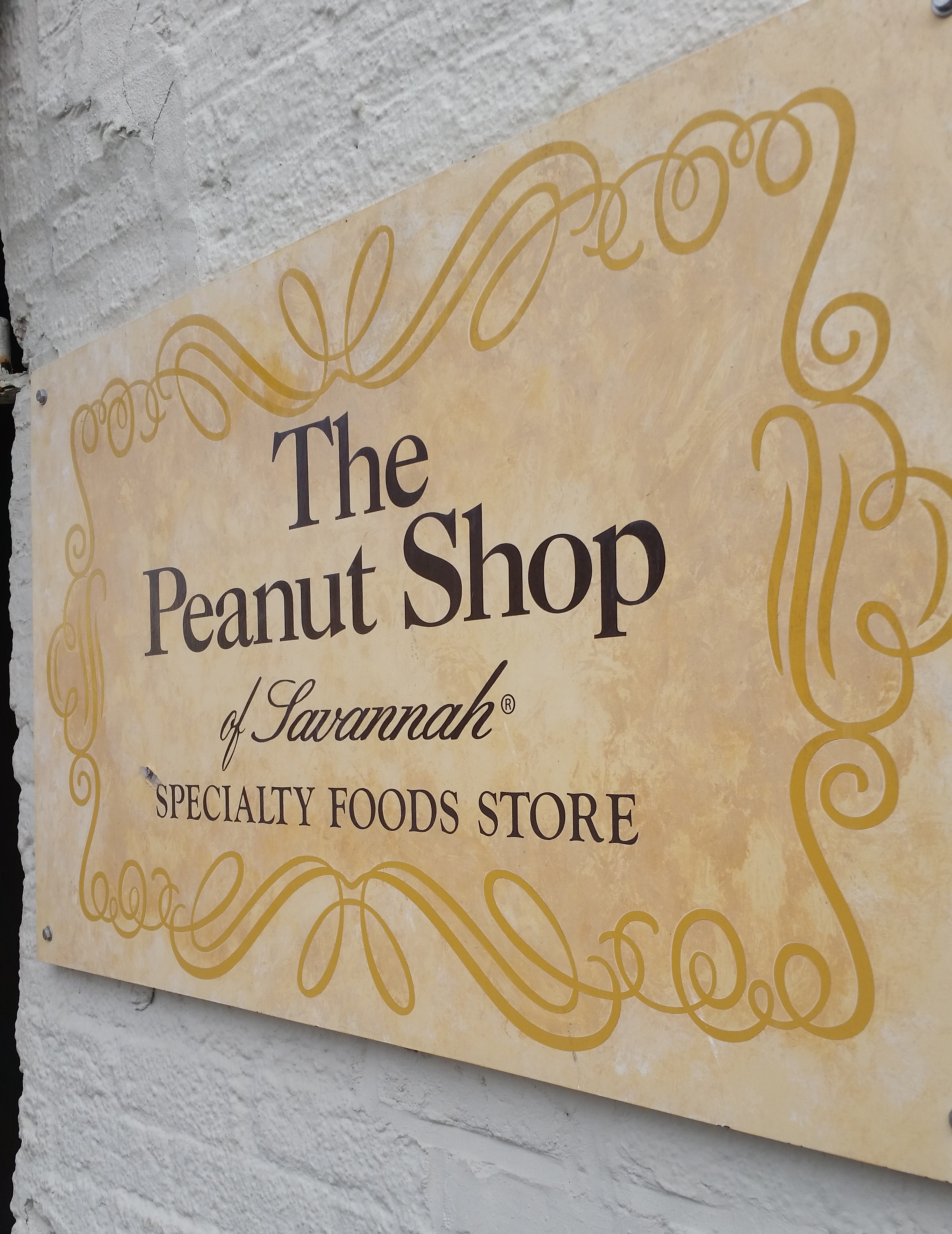
If you are ever in Savannah walking around River St. then you should stop by The Peanut Shop for samples of everything peanut. There is roasted peanuts, peanut brittle and peanut butter. However, the hundreds of cans of roasted peanuts are not your traditional salted peanuts. No, these cans are everything from Savory Dill Pickle, Bloody Mary, Sea salt and Cracked Pepper, Thai Fried Chili Lime, Spicy Mole, Salt and Vinegar, Spicy Smoky Redskin, Hot Habanero Chile Pepper, Bacon and Cheddar and more. The best part is free samples. If you are a peanut lover then be sure to visit The Peanut Shop the next time you are in Savannah.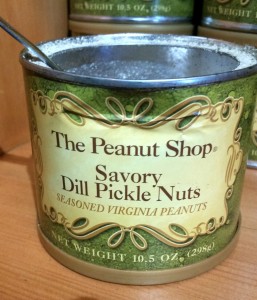
Following the tour of the Port of Savannah, tour attendees had a couple of hours to visit River Street before setting sail on the Savannah Riverboat Cruise. The two-hour cruise gave attendees an opportunity to see the city from a different view while enjoying good food and entertainment. If you are ever in the Savannah area then check out the riverboat cruise for a fun and relaxing time.
View the 2014 Georgia Peanut Photo Album.
Thai Fried Chili Lime Peanuts
Thai Fried Chili Lime Peanuts