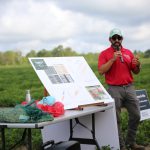
 Nino Brown, University of Georgia peanut breeder provided an update on the university’s peanut breeding program during the 2026 Georgia Peanut Tour. Brown develops new peanut varieties for growers in Georgia as well as surrounding states, with a focus on developing varieties that meet the needs of growers and others throughout the peanut industry.
“Our primary customer is the grower, and that’s who we really strive to serve first and foremost,” Brown says. The breeding program focuses on improving yield, grade, disease resistance and agronomic characteristics, while also addressing traits such as nutrition, flavor and composition. Brown says the goal is to develop varieties that serve the needs of growers, shellers, manufacturers and consumers.
Because peanuts are grown across many different environments in Georgia, Brown says the varieties developed by the breeding program need to perform well throughout the state. That makes stability an important consideration in the breeding process. Brown defines stability as a variety’s ability to perform at a high level across many different environments. Researchers test new varieties at as many locations as possible to identify lines that can consistently perform well under different growing conditions.
The University of Georgia’s research and education centers provide a network of locations across the peanut-growing region for those trials. Brown says the breeding program has trials in Attapulgus, Camilla at the Stripling Irrigation Park, Plains, Tifton, Chula and Midville. Testing varieties across these locations allows researchers to evaluate how they perform under a range of environmental and growing conditions.
Midville is a particularly important testing location for the breeding program. Brown describes it as a unique environment for Georgia and one of the program’s largest yield trial locations. A major focus is ensuring that varieties developed in Tifton can also perform at a high level in Midville and other areas of eastern Georgia.
Developing varieties with those traits requires significant effort and financial investment, making support for the breeding program an important part of the process. “It takes a lot of effort, a lot of money to be able to achieve those things, and so we’re really grateful for the support from the Georgia Peanut Commission to achieve those goals that we’re trying to accomplish,” Brown says.
View the 2026 Georgia Peanut Tour Photo Album