Research Spotlight on Replanting Decisions

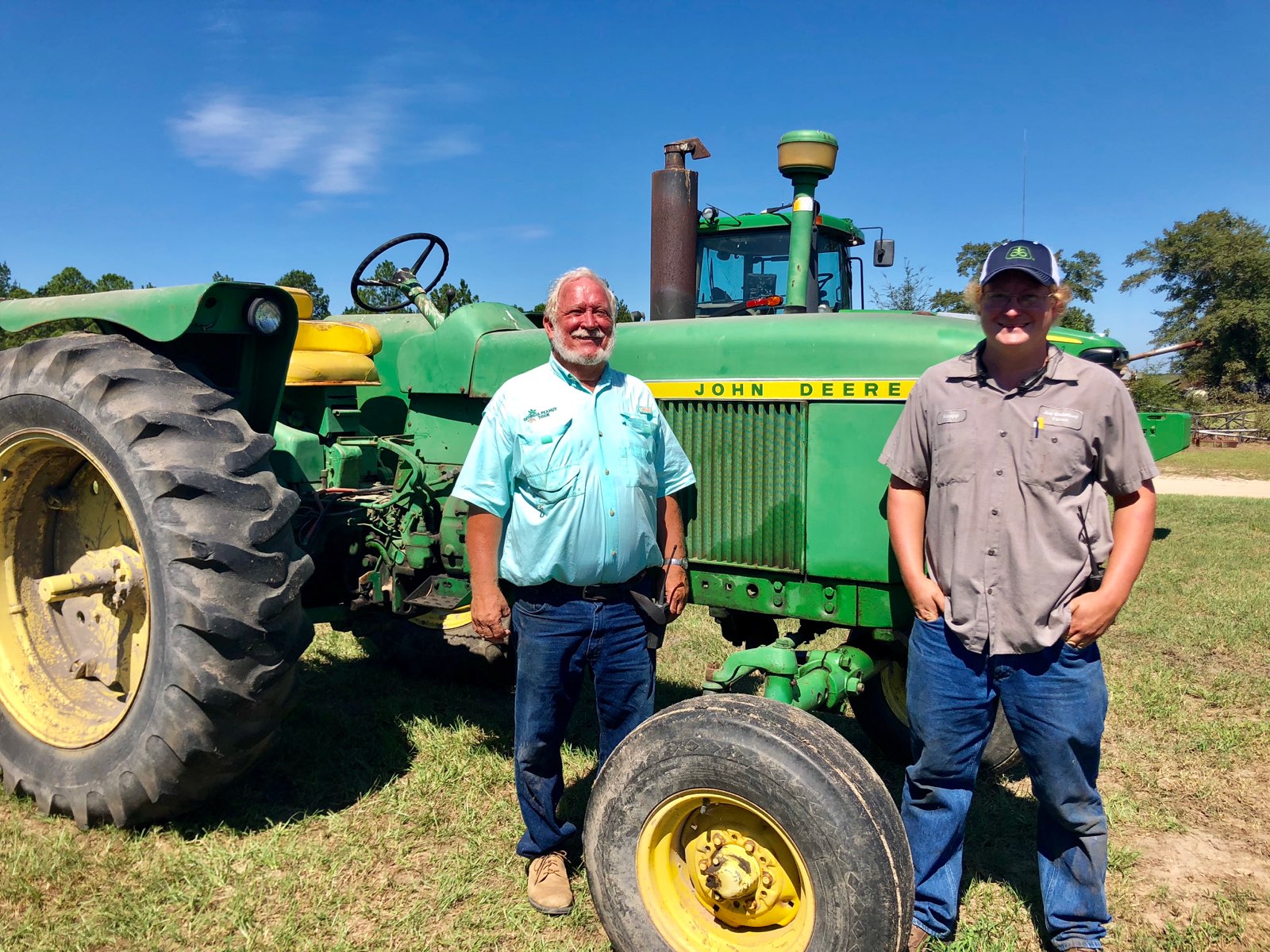
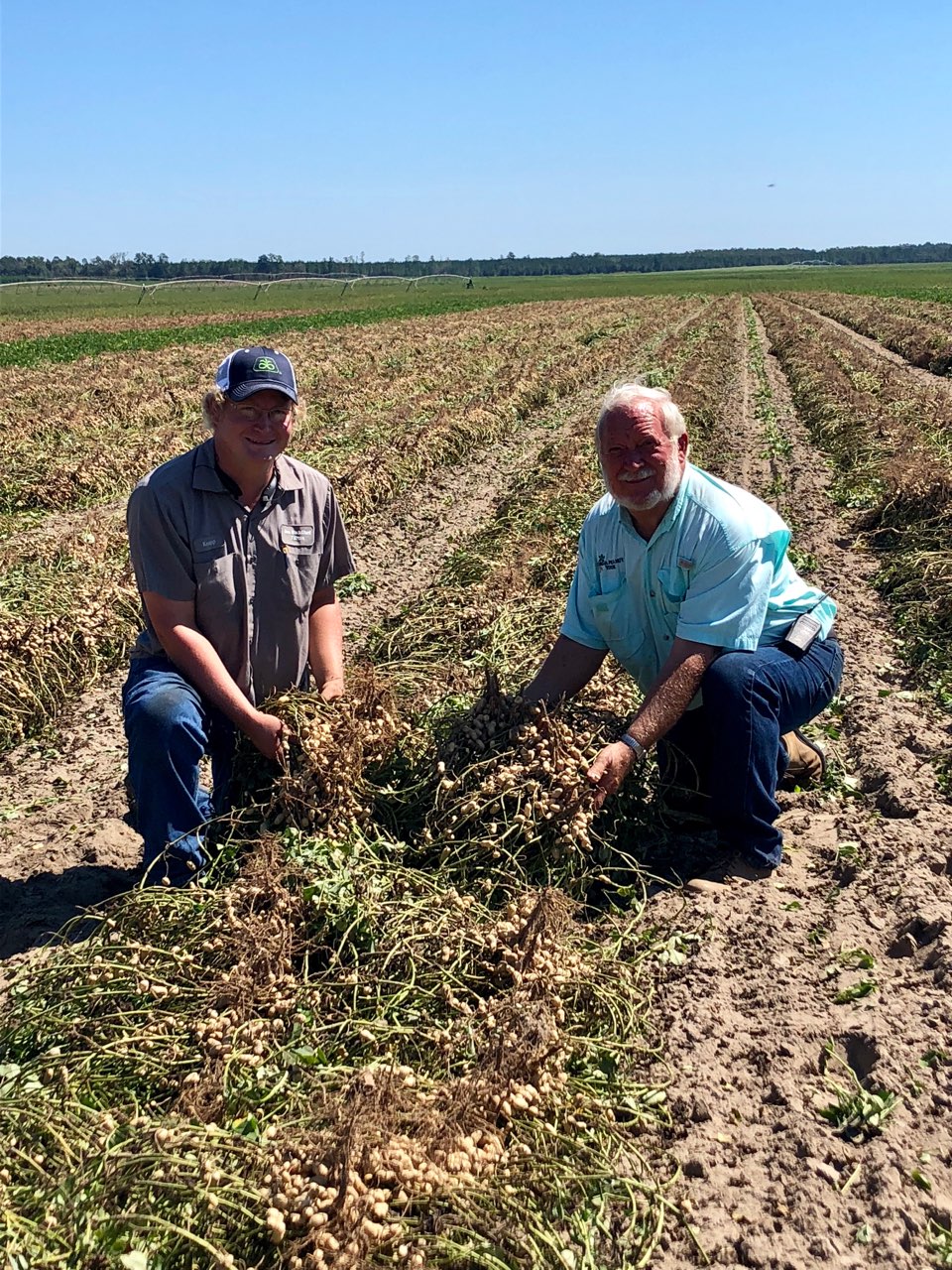
Scott Tubbs, cropping systems agronomist with the University of Georgia in Tifton, Georgia, focuses his research efforts on peanut agronomic research. He initiated several trials to assess replant decisions in peanuts. Through his research he is assessing what is the original plant population and at what point does it trigger a replant decision for a farmer based on that original plant population. He has tried several different methods of replanting that could include replanting by planting next to the original row or wiping out the original row completely and just starting over with an entire new replant for the full field being a maximum seeding rate.

In one trial in Tifton, Georgia, Tubbs has a replant trial where he is only replanting the initial gap in the field by forcing a two foot, four foot or six foot gap in the row where the original plants were pulled out of the ground and then replanting that either in that gap or replanting the entire row. This can make it easier on the equipment and the driver to not have to assess where the gaps occur but the final phase of this project will be to hopefully use equipment where Tubbs can assess the gaps in the row while the machinery is moving through the field and only replant the sections of row that need to be replanted based on the research that he has for yield drag, for a length of gap and the potential to improve grade as well.

The replant trials have multiple phases and locations including one in Plains, Georgia at the Southwest Georgia Research and Education Center. The research projects in Plains this year are in phase 2 where they are assessing only the yield drag alone in the length of gap. In those trials, Tubbs has one foot, two foot and three foot gaps in the row after the initial planting by forcing and pull thinning those plants out to force those gaps in the row and those gaps of one, two, and three foot occur either twice or three times in each 40-foot row. So essentially, the plots end with nine feet out of 40 feet of row missing from the field or roughly very close to a 25 percent stand decline from what the original plant stand could be, but that research by itself does not assess the replant decision.

That’s where our phase three project comes into play in Tifton this year where we are not only removing the gaps but we’re also replanting the gaps in the gap alone or with a full row replant so there are multi phases to this project that occur over time and in multiple locations, Tubbs says. The ultimate goal of this research is to help farmers assess a plant stand in the field and determine whether that plant stand is either uniform enough to leave alone or if it is spotty enough to require a replant decision, to helping them improve either yield or grade or hopefully both.

The research by Tubbs goes into more than just replant decisions. Some of his work focuses on rotations, how many years between peanut and how does that affect the plant when it grows in the field. Shorter rotations have a tendency to increase disease and nematode issues on peanut and can cause issues with herbicide resistance with weeds. Tubbs is also focusing some of his research on inoculants and inoculate formulations, when to use inoculants, how much benefit do we get from inoculants either in short rotations versus long rotations. He has also focused some research effort on tillage research conservation or conventional tillage research and seeding rates.

View the 2017 Georgia Peanut Tour Photo Album.

Dr. Culbreath speaks on tomato spotted wilt and leaf spot

Albert Culbreath, a 28 plus year professor of Plant Pathology at the University of Georgia Tifton campus, works primarily with foliar fungal diseases of peanut and tomato spotted wilt virus of peanut. Culbreath arrived at UGA shortly after tomato spotted wilt showed up, so needless to say they have a long history. “We’ve made tremendous progress dealing with that disease but it’s still around and still causes problems. Leaf spot has been a problem with peanuts as long as we’ve been growing peanuts in Georgia. We’re working on resistance and integrated management for both of those diseases, but with the leaf spot we’re still very heavily dependent upon fungicides for control of those,” says Culbreath. An awful lot of his work is geared toward looking with the different breeding programs, trying to help develop and utilize better resistance to spotted wilt and the leaf spot diseases.

The spotted wilt part of peanut RX is a tremendous decision tool for growers so the biggest factor with that is the ranking of variety for resistance to tomato spotted wilt. “We spend a lot of time trying to rank the cultivars depending on how susceptible or resistant they are. That’s the primary thing after planning date choice and typically with tomato spotted wilt, the earlier you plant, the greater the risk of damage from spotted wilt so if you’re planting a more moderately resistant variety or more susceptible variety, you would want to dodge an early planting,” the UGA researcher continued. The peanut RX would help with decisions like that. We only have one insecticide that provides suppression of spotted wilt. Thimet. There’s currently a few insecticides that work well on thrips or control the vector of spotted wilt, but Thimet is the only one that helps suppress the disease itself so those all come into play. Those are incorporated into the index and the index also helps you look at the additive effects of the different factors We will use the RX for the other diseases too and things like planting dates are just the opposite for tomato spotted wilt and leaf spot. “The earlier you plant, the higher the risk for tomato spotted wilt but the lower the risk for leaf spot”, says Culbreath. “If you have a low risk variety for tomato spotted wilt, we’re using that to let growers know that you can plant and dodge some of the leaf spot pressure. We have severe problems with fungicide resistance to some of the fungicide classes,” he adds. Some fungicides don’t work alone in Culbreath’s fields now so he’s looking at different combinations, different alternations that will prolong the utility of those fungicides so that’s the main focus of what he has going on in Plains at the University of Georgia’s Southwest Georgia Research & Education Center.

View the 2017 Georgia Peanut Tour Photo Album 

Georgia peanut entomology update

While at the University of Georgia’s Southwest Georgia Research & Education Center, tour attendees received a peanut entomology update from Dr. Mark Abney. Dr. Abney is a research and Extension entomologist at the University of Georgia located on the Tifton Campus. The primary focus of his research and Extension program is the development and implementation of economically and environmentally sustainable insect management strategies for pests of peanut.

At the center, Dr. Abney discussed Southern Corn Rootworm, one of the most common pests peanut farmers face in the field. The Southern Corn Rootworm is a pest that harms the peanut plant underground, where it feeds on the actual peanut pod itself. Because it is underground, it is difficult for peanut farmers to monitor and manage the pest to prevent damage and loss of the peanut plant. Currently, there are not a lot of insecticides available to manage Southern Corn Rootworm, so Dr. Abney is researching the use of alternative insecticides. He said his current research trial looks promising.

Corn rootworm larva and damaged peanut pod - Photo courtesy of UGA peanut entomology.

Corn rootworm larva and damaged peanut pod – Photo courtesy of UGA peanut entomology.

Dr. Abney says UGA’s peanut entomology department is diverse. The department is doing a lot of work pertaining to efficacy and thresholds of specific pests like thrips and others. They are also looking into the use of alternative insecticides for products that are being phased out or taken off the market and made unavailable to growers. Lastly, work is being done to understand the biology of the peanut burrower bug in a way that will help growers manage the pest better and reduce damage to their peanut crop.

Peanut burrower bug - photo courtesy of UGA.

Peanut burrower bug – photo courtesy of UGA.

For more information the UGA entomology department, click here.

View the 2017 Georgia Peanut Tour Photo Album 

Research Opportunities Abound at the Southwest Georgia Research & Education Center

swgaresearchandeducationcentersignThe Southwest Georgia Research and Education Center lies in the upper Coastal Plain near Plains, Georgia. The 512-acre center was established in 1951, when local citizens deeded 453 acres to Sumter County and later to the University System Board of Regents. The station’s purpose was to stimulate the depressed rural economy by helping area farmers diversify and increase crop yields.

The site was selected because of its heavy red clay soil, which is predominant in this region of the state. It is difficult soil to farm, but can be highly productive when carefully managed. Research here is geared to the 240-day growing season and average annual rainfall of 48 inches. Nine full-time employees maintain research for UGA College of Agricultural and Environmental Sciences and U.S. Department of Agriculture researchers.

Current research focuses on every major row crop in south Georgia, including peanuts, cotton, corn, soybeans, grain sorghum, wheat, canola, peaches, watermelons and pecans. Animal scientists use the station’s 80-head cow-calf herd to conduct breeding and forage studies. The addition of irrigation in the mid-1980s made it possible to maintain crops during the area’s frequent droughts.

View 2017 Georgia Peanut Tour Photo Album.

Plains, Peanuts and a President

IMG_4642

Plains, Georgia and President Jimmy Carter go together like peanut butter and jelly, that’s why the Georgia Peanut Tour would not have been complete in this area of the state without a visit to the home of the 39th President of the United States. Tour attendees were able to visit President Carter’s Boyhood Home and learn firsthand about the life of President Carter as a child. The former president talked about his days living in Plains and then in the White House. President Carter started his peanut business at the young age of five. That’s when he pulled up peanuts from his father’s field, cleaned them and boiled them. He then headed into Plains, Ga. to sell the boiled peanuts. He made money selling the boiled peanuts until he was 8 years old.

President Carter owes much of his success today to his life in Plains and growing up on the farm. Today, President Carter and Rosalynn are active with Habitat for Humanity. The Georgia Peanut Tour Committee chair, Glen Harris presented President Carter with a Georgia Peanut Tour shirt and gift basket filled with Georgia peanuts and peanut novelty items
.IMG_4651 Also at this tour stop, attendees were able to enjoy grilled pb&j’s presented by the National Peanut Buying Point Association. These sandwiches are a favorite for tour attendees- President Carter even swiped one up before taking a group photo with the crowd.

IMG_4657

The 39th president, Jimmy Carter enjoys a grilled PB&J

This weekend, Sept. 23, the town of Plains celebrates with the annual Plains Peanut Festival. There are several activities planned all weekend. To learn more about the festival click here.

View the 2017 Georgia Peanut Tour Photo Album

2017_gpt_albany_0137s


Israel farm takes pride in growing quality peanuts in Sumter County

The Georgia Peanut Tour kicked off day two in Sumter County at the farm of Hal Israel. Israel has been farming for 40+ years and manages an operation of 1,500 acres. Along with 530 acres of peanuts, Israel also grows cotton, corn, soybeans and wheat. When asked about his peanut crop, Israel said most of the crop is grown for seed and 90 percent of the crop is irrigated. His peanuts are planted on a two to three year rotation to assist in disease management and he said most of his challenges are weather and pigweed. During the field stop, Israel showed tour attendees a new variety he is growing called GA-16HO. This variety is high-oleic and yields similar to the popular variety, GA-06G. This particular field, right at 145 days old, is estimated to yield an average of 5,800 pounds per acre.

Hal Israel visiting with tour attendees about his farming operation in Sumter County.

Hal Israel visiting with tour attendees about his farming operation in Sumter County.

GA-16HO, the new variety Israel has planted.

GA-16HO, the new variety Israel has planted.


IMG_9750[1]

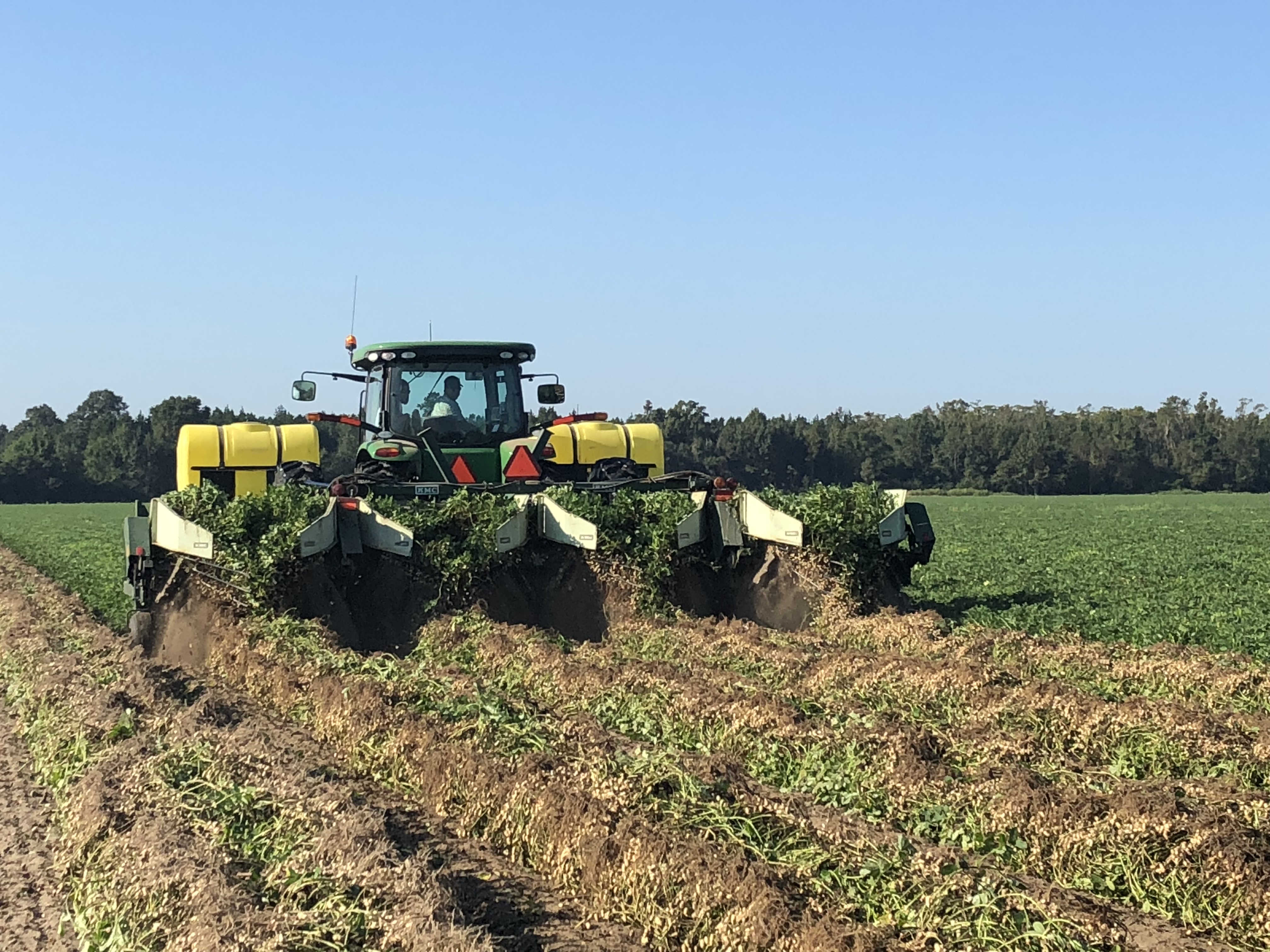
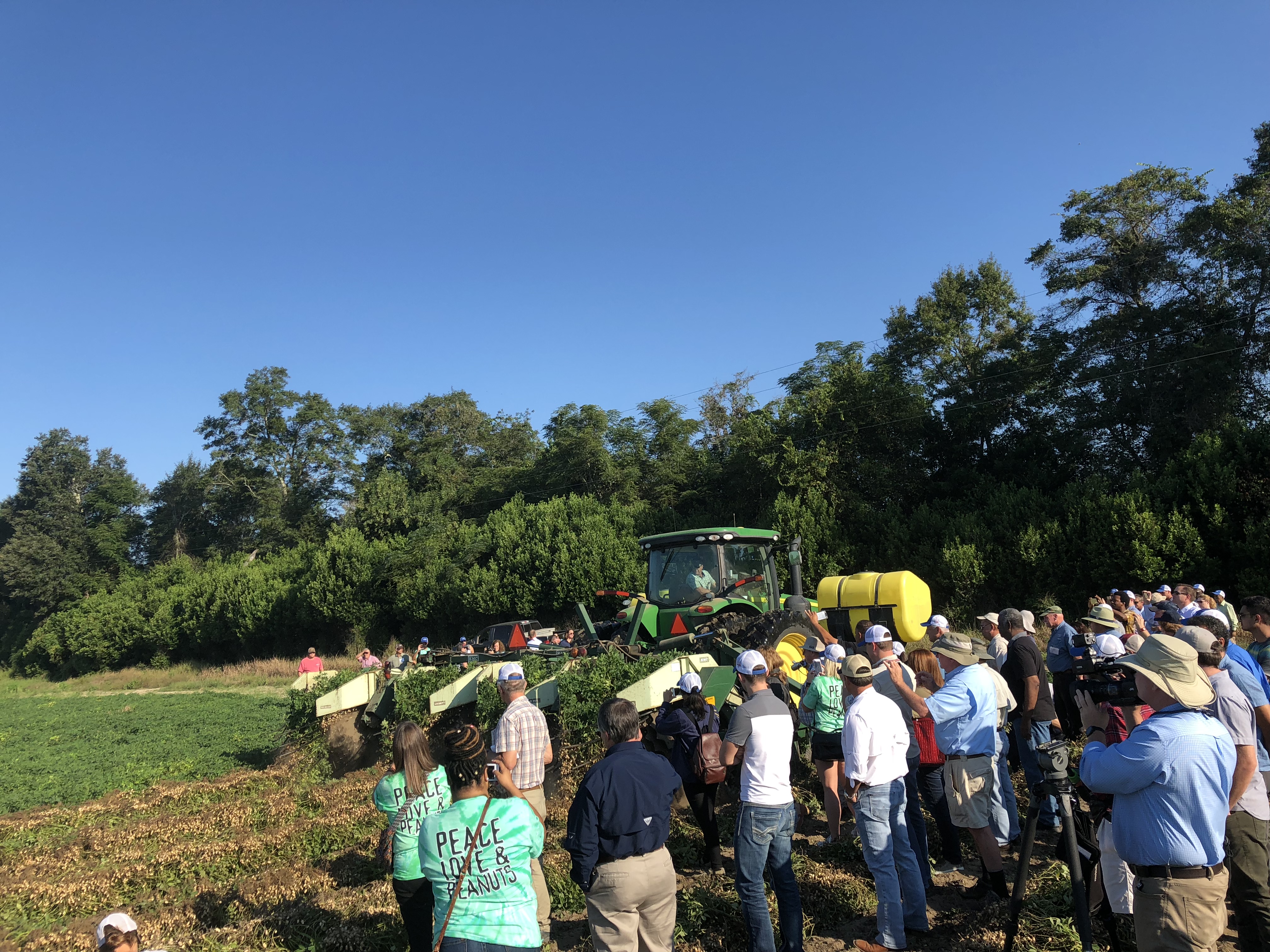
Tour attendees watching peanuts being dug at the Israel farm.

Dr. Bob Kemerait, Extension plant pathologist at the University of Georgia located on the Tifton Campus, showed tour attendees examples of mild late leaf spot in the field and talked about how Israel incorporates an excellent management approach in his farming operation.

Dr. Bob Kemerait, UGA Extension plant pathologist, showing tour attendees examples of late leaf spot.

Dr. Bob Kemerait, UGA Extension plant pathologist, showing tour attendees examples of late leaf spot.

According to Bill Starr, Sumter County Extension agent, the county averages around 15,000 acres of peanuts each year. Yields average 4,800 pounds per acre and 80 percent of the county’s peanuts are irrigated. Starr also mentioned a large portion of the county’s peanuts are grown for seed. He rates the current peanut crop as good to excellent in most fields. Other major crops grown in Sumter County include: cotton, corn, pecans and vegetables (primarily snap beans). When asked about the most troublesome production issues this year, Starr said whiteflies in cotton and vegetables, difficult weather and disease problems have all presented challenges for growers in his area.

Bill Starr, Sumter County Extension agent, visits with tour attendees about Sumter County ag production.

Bill Starr, Sumter County Extension agent, visits with tour attendees about Sumter County ag production.

To view a video clip of the GA-16HOs being dug, click below.

View the 2017 Georgia Peanut Tour Photo Album

Food Safety is a Priority in the Peanut Industry

Food safety was a primary topic during the Georgia Peanut Tour Hot Topics seminar. Attendees were able to hear updates from researchers at the University of Georgia Griffin Campus and from JLA USA.

Anand Mohan, UGA researcher, focused his presentation of FSMA and its effects on peanut processing. Food facilities are required to register with FDA under sec. 415 of the FD&C Act. The researchers at Griffin Campus are working to provide food facilities assistance with a food safety plan, preventive controls, management responsibility and principles of equipment design.
View Anand Mohan’s presentation.

In addition to learning about new regulations, attendees were able to learn about some of the peanut related food safety issues from Francisco Diez-Gonzalez, director of the UGA Center for Food Safety. According to Diez-Gonzalez, there are different type of foodborne diseases in foods ranging from intoxications, infections and sensitivies. The peanut’s main food safety risks are allergies, mycotoxins and salmonella.
View Francisco Diez-Gonzalez’s presentation.

The final presenter in the food safety panel, Jack Davis of JLA USA, presented information on managing aflatoxin in peanuts. Aflatoxin is a prominent class of mycotoxins which are a product of fungal growth and invisible to the human eye. The Food and Agricultural Organization estimates 25 percent of the World’s crops are contaminated by mycotoxins. Aflatoxin contaminates a range of important crops including corn, peanuts, cotton, rice, nuts, chiles and spices. The U.S. peanut industry has invested heavily over the past fifty plus years to miniize aflatoxin in the edible market.
View Jack Davis’s presentation.

View 2017 Georgia Peanut Tour photo album.

The Sustainable Peanut

img_7560Peanuts are a sustainable crop because of their nitrogen-fixing properties that benefit soil and other crops. Now researchers are recommending that farmers plant sod in rotation with peanuts to further improve the sustainability of the land, and the health of America’s favorite nut. During the Georgia Peanut Tour Hot Topics seminar, sustainability efforts of the peanut industry were presented to attendees.

David Prybylowski, sustainability consultant for the American Peanut Council, provided an update on the peanut industry’s initiatives regarding sustainability. According to Prybylowski, meeting the needs of the present while improving the ability of future generations to meet their own needs by increasing productivity, improving the environment and improving profitability for growers. Simply put, getting more peanuts from the same or less inputs.

Prybylowski shared a crop comparison water footprint of shelled peanuts versus shelled almonds, walnuts and pistachios. Shelled peanuts utilize 4.7 gallons of water per ounce while almonds use 80.4 gallons of water per ounce, walnuts use 73.5 gallons of water per ounce and pistachios use 16.8 gallons of water per ounce.

Even with this outstanding data on water usage, the peanut industry is still working towards measuring sustainability as the science continues to advance. In fact, Georgia has brought together farmers, researchers and other industry representatives in a pilot project through the Georgia Peanut Sustainability Initiative. According to Marshall Lamb, committee member of the Georgia Peanut Sustainability Initiative, the initiative plans to gather initial farm-level data on sustainability efforts to help provide data to better understand the efficiency, conservation and economic returns to producers. Additional projects include development of education and outreach programs to help peanut producers and continue to educate consumers with sustainability messaging.

For additional information on the sustainability efforts of the U.S. peanut industry click here.
View David Prybylowski’s presentation.
View Marshall Lamb’s presentation.

View the 2017 Georgia Peanut Tour Photo Album.

Update on the 2017 Peanut Crop and Farm Bill

2017_gpt_albany_0001

Scott Monfort – University of Georgia peanut agronomist

To kick off the 31st annual Georgia Peanut Tour attendees were able to learn more about the peanut crop and food safety during the Hot Topics Seminar Tuesday afternoon. During the seminar Scott Monfort, University of Georgia peanut agronomist, provided an update on the 2017 peanut crop. According to Monfort this is the third year that Georgia has had more than 700,000 acres planted to peanuts. For the 2017 crop, 828,000 acres were planted with a predicted yield of 4,600 lbs. per acre. However, the weather and other complications could have an impact on the final production for the year. The year 2017 did bring the longest planting season on record going from March 27 to July 5, according to Monfort.  However, some farmers did have poor stands due to weather and poor vigor of the crop, chemical injury, aspergillus crown rot, aspergillus flavus, nematode damage as well as damage from hogs and simple grower mistakes. Then recently farmers had to deal with Hurricane Irma. However, many farmers were able to pick their peanuts before the hurricane hit or the peanuts were still in the ground. However, farmers who also grow cotton or pecans had damage to those crops. Overall, Monfort says irrigated yields and quality so far have been above average. Some of the non-irrigated yields were impacted by the dry weather in August. However, time will only tell in the final outcome of the 2017 Georgia peanut crop.

View Scott Monfort’s presentation.

In addition to the crop update, Stanley Fletcher, director of the National Center for Peanut Competitiveness, provided an update on the farm bill discussions. According to Fletcher, many of the farm bill mark-ups will take place this fall and may be considered in the U.S. House and U.S. Senate at that time. However, it is too soon to know when the final bill will pass Congress. Fletcher also provided an update on the Representative Peanut Farms. The 22 farms across the U.S. provide Fletcher with information on the operating costs and other expenses on the farm. This data helps Fletcher provide an economic analysis on what will work or not work for peanut farmers across the U.S. in the farm bill.

View Stanley Fletcher’s presentation.

Welcome to the 31st annual Georgia Peanut Tour

glenharris

Glen Harris – 2017 Georgia Peanut Tour Chairman

Welcome to the 2017 Georgia Peanut Tour. Whether this is your frrst time with us or you are a “Peanut Tour Veteran,” we are honored and privileged to have you join us again on our 31st annual tour. Like all of the previous peanut tours, you will be immersed in one of Georgia’s most important agricultural crops from the field to the manufacturer. We sincerely appreciate each of you for joining us on this exciting tour and hope, through the experience of this tour, you will understand and appreciate the heritage of peanut production in our state. Each of us engaged in the peanut industry – farmers, buyers, processors, researchers, Extension personnel, Georgia Peanut Commission representatives and everyone in between, are proud Georgia is the leading peanut producer in the United States, and we are all the more happy you could join us for the next three days as our special guests!

The 31st annual Georgia Peanut Tour will kick off on the afternoon of Tuesday, Sept. 19, with a “Hot Topics” symposium located at the Merry Acres Conference Center in Albany, Georgia. Expert speakers will address the current status of our peanut crop and also focus on the importance of University research in sustaining peanut production in Georgia. Symposium speakers will discuss recent innovations and research in peanut production, breeding, pest management, engineering, storage and handling, and processing.

Day two is jam-packed starting with a field visit to watch peanuts being dug and inverted. Then, on to a unique Georgia peanut experience, to visit and meet a former president of the United States of America at his childhood home; one of the most famous Georgia Peanut farmers ever, Jimmy Carter. From there, we will visit a University of Georgia experiment station, a seed peanut facility, a peanut buying point and a second field visit to see peanuts being picked after they have dried. On day three, we will visit the USDA National Peanut Lab and a key food safety company. And as always, we will eat well on the tour including Southern barbeque and a low country boil. In addition, you will hear directly from farmers and county agents at the field stops about the challenges they face and the solutions they adopt to produce a vibrant peanut crop. Further, you will hear from researchers and Extension faculty at UGA about their efforts to find innovative ways to aid farmers and improve peanut production. Most of this effort is funded through the Georgia Peanut Commission, which invests money from growers today for better production in the future.

Again, on behalf of the Peanut Tour Committee, made up of members from the USDA-ARS Peanut Lab, the Georgia Peanut Commission and the University of Georgia, we warmly welcome you to the 31st annual Georgia Peanut Tour! We hope, over the next few days, you will learn about the complexity of the peanut industry in Georgia and the personal commitments from all involved in producing the world’s finest peanuts! We hope our events will allow for fellowship and you enjoy Georgia’s renowned hospitality. We offer our sincere thanks to all the sponsors, who through their generosity, help make this tour possible.